Current Event Report Assignment Information

| WH Current Event Report Instructions |
Common Mistakes Made by Students on their Current Event Reports
#1 Not writing enough information in the "Paraphrase the article" section
#2 Forgetting to do the last one or two sections of the report
#3 Not using an article from our website or one approved by me
#4 Forgetting to underline the Headings
#2 Forgetting to do the last one or two sections of the report
#3 Not using an article from our website or one approved by me
#4 Forgetting to underline the Headings
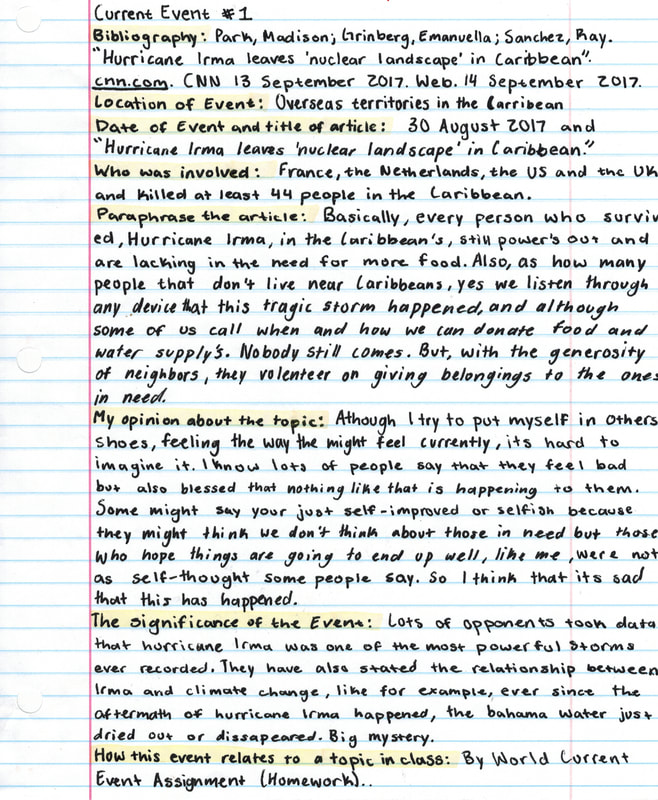
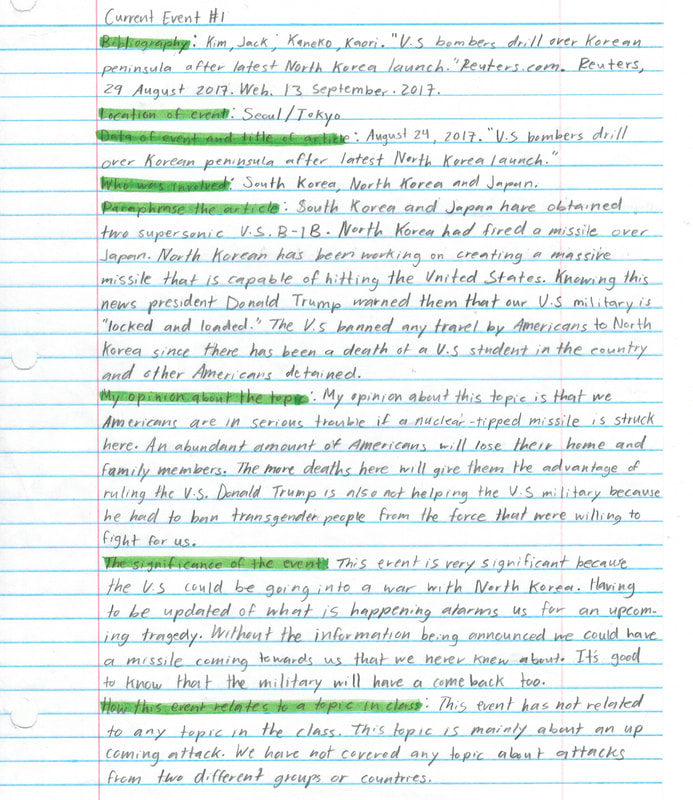
Current Event Report Student Examples



How to Find Credible Resources
One of the skills you can learn by this assignment is the ability to better judge whether the information from an online source is credible. Credible means that information is accurate, complete, and true. For a news article this means that multiple points of view are included in the piece. When the piece is an editorial or essay, the author will express his or her opinion but should still acknowledge a counter-argument. Finally, a credible piece will cite other credible sources.
What factors make a source credible?
www.latimes.com/world/
www.washingtonpost.com/world/
www.nytimes.com .
www.guardian.co.uk
www.reuters.com/news/world
www.bbc.com
www.wsj.com/news/world
aljazeera.com
time.com
newsweek.com
inkdrop.net/dave/news.html
thebigproject.co.uk
One of the skills you can learn by this assignment is the ability to better judge whether the information from an online source is credible. Credible means that information is accurate, complete, and true. For a news article this means that multiple points of view are included in the piece. When the piece is an editorial or essay, the author will express his or her opinion but should still acknowledge a counter-argument. Finally, a credible piece will cite other credible sources.
What factors make a source credible?
- The publication has a reputation for credibility. Check to see how long it has been published. Do its stories refer to studies done by a university or government? The publication is a university or professional journal. Does the publication focus on one topic, such as National Geographic; or does it have a mix, like Time? Either is fine, so read an article or two to see if they appear to be credible. Style and grammar are formal.
- The author is well-qualified to write on the given topic. In other words, is he or she an expert? Does the author have college degrees, work experience, travel experience, or life experience that is important? Was the author present when the event happened? Has the author published books or other articles on this, or a related, topic? Sometimes there is a sentence at the end of a piece indicating what the author's background is. Style and grammar are formal.
- We are living in an era of rapidly expanding communication options. Personal blogs, twitter feeds, or videos may be relevant and credible sources in certain situations. For example, someone who blogs or makes a video about his or her daily life in Iraq, might be providing credible information if he or she refers to real events, states his or her own opinion instead of generalizing ( "I am angry about..." instead of "Everyone is angry about..."), and identifies his or her background and/or biases ("I have lived in Baghdad my entire life", or "I'm a doctor and am trying to raise awareness about our need for donated medical supplies at my clinic", or "I'm fifteen and wonder what kind of life I can have. There has been war in my country as long as I can remember.") You will have to make judgment calls when considering these sources.
- .edu This means that the source was published by a college, university, or institute affiliated with a college or university. Researchers are held very high standards, and their work is thoroughly reviewed by peers before it is published.
- .gov This means that a resource was published by a division of the United States government. Government publications are held to the same standards as those from a university. Please note that the governments of foreign countries will have a different domain name.
- .org Usually this means that the source was published by a national or international nonprofit organization such as the United Nations, Habitat for Humanity, or Doctors without Borders. Some governments refer to nonprofit organizations as NGOs, or Non-Governmental Organizations, and those are credible, too. Major museums sometimes use this domain; The Metropolitan Museum of Art in New York is found at metmuseum.org.
- .com By far the most common domain, this is where you will need to use the guidelines found on this page and your own judgment. Many respected news organizations use this domain; useful examples are listed below, but you will discover others on your own.
www.latimes.com/world/
www.washingtonpost.com/world/
www.nytimes.com .
www.guardian.co.uk
www.reuters.com/news/world
www.bbc.com
www.wsj.com/news/world
aljazeera.com
time.com
newsweek.com
inkdrop.net/dave/news.html
thebigproject.co.uk
